Tuesday, September 19, 2017


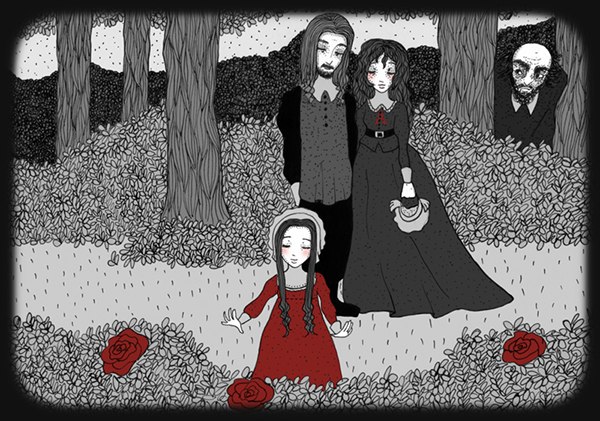
When Hester and Dimmesdale are waiting for Pearl to join them in the woods, Dimmesdale ponders "that this brook is the boundary between two worlds, and that [they] canst never meet Pearl again" (143). What do you think is the purpose of this metaphor, and why does Dimmesdale observe this? - Zach Lin (8th prd)

In chapter 20, on page 148, when Reverend Dimmesdale returns to the town after he makes plans with Hester to run away, it is described that "it was the same town as heretofore; but the same minister returned not from the forest." What brought about this change? Was the change good or bad? Why? How will this change in character affect his character from here on? - Mary (1st prd)

On page 145, Pearl had kissed her mother once she had put back on the Scarlet letter, Hawthorne then writes "But then-- by a kind of necessity that always impelled this child to alloy whatever comfort she might chance to give with a throb of anguish-- Pearl put up her mouth, and kissed the scarlet letter too!" What do you think is the reasoning behind this action? Does Pearl value the scarlet letter's presence just as much as her mother? (Destiny - 8th prd)


On pages 146 and 147, Hester and finds a crew and ship that will depart to England in a few days. Hester is planning on going to England with Pearl and Dimmsdale. Do you believe she is running away from her problems with him, or do you think what she is doing is beneficial for her as well as Pearl? - Lahari (3rd prd)

Group Guidance in Reber tomorrow

Finish the book  - chapters XXI-XXIV (155-180) - for Thursday and post one discussion question and respond to another (by 7am Thursday morning)


Monday, September 18, 2017

Silent Reading
Vocabulary Quiz
No content quiz


HW: Finish reading 141-154 and post one question on turnitin.com and respond to another. Also, please bring a handwritten copy of your question to class tomorrow. Discussion most of class tomorrow.


9/18
SL Reading Day
Post disc questions
9/19
SL XIX-XX (141 -154) discussion


9/20
Late Start Day

Group Guidance


9/21
Discuss SL XXI-XXIV (155-180)

9/22
SL End of Book Quiz

Friday, September 15, 2017

AP-style close reading quiz...(25 minutes)

Small group discussion

Respond to one of the two:
1)      Question: Chapter 15 emphasizes "Pearl's inevitable tendency to hover about the enigma of the scarlet letter" (123). How does Pearl seem to be somewhat aware of the meaning of the scarlet letter? What does she seem to think of it? Why is highlighting her intuitiveness and curiosity important to the story? 


2)      Discussion Question: At the end of chapter XVIII, it is noted about Pearl's interaction with the nature, which acts as a character, that "the mother-forest, and these wild things which it nourished, all recognized a kindred wildness in the human child" (140). What idea might Hawthorne be trying to convey by exploring Pearl's intimate interaction with the natural world? How might this relate to Pearl's representation of American Romanticism?

For Monday...

Quiz on chapters 9-13 vocab (10 questions for 10 points)


Quiz on content, chapters 10-18 (8 questions for 16 points)


9/18
SL Reading Day
Post disc questions
9/19
SL XIX-XX (141 -154) discussion


9/20
Late Start Day
SL Reading Day


9/21
Discuss SL XXI-XXIV (155-180)

9/22
SL End of Book Quiz


Thursday, September 14, 2017

- Discuss close-reading questions one and two
- Small group discussion

Homework:
Close reading quiz tomorrow (no quote identification or vocabulary questions)...bring your glossary of rhetorical terms tomorrow


Wednesday, September 13, 2017

Silent Reading

For 1 and 2...provide a definition and an example from the passage, from another part of The Scarlet Letter, or from outside the text, as appropriate.

1. a) parallel structure (1)
b.) exclamatory sentence (2)
c) hyperbolic language (3)
d) What is a metaphor? What is an allusion? Although there are not allusions in this passage, find a Biblical allusion in The Scarlet Letter. (4)
e.) rhetorical question (5)

2). a) euphemistic language (6)
b)  mollyfying tone (7)
c) lack of specificity (8)

1.     Parallel structure
2.     Exclamatory sentences
3.     Hyperbole
4.     Metaphor
5.     allusion
6.     Rhetorical question
7.     Euphemism
8.     Mollifying 
9.     Metonymy
10.   Oxymoron
11.   Paradox

HW: For chapters XV - XVIII, post one discussion question and respond to another.  Also, from chapters XV-XVIII post the vocabulary word, the sentence and page number where you found it, and the definition of the word. Respond by no later than 7am tomorrow to get credit. (2 points)

Also add the following to your Rhetorical Glossary terms (look these up and add defintions and examples to your glossary):

understatement
simile
analogy
abstraction

Friday we will have another Scarlet Letter close-reading quiz and also some content questions from chapters 11-18 (quote identification).  You may use your Glossary of Rhetorical Terms on the quiz.


9/11

Discussion of Scarlet Letter Topics (25 mins)


Silent Reading (25 mins) 


9/12

SL XI-XIV (95-120) Disc


9/13

SL Reading Day

Post disc quests

9/14

N.C. OPEN HOUSE

SL XV-XVIII (120-141) disc


9/15

TBD

Tuesday, September 12, 2017


What do you feel is the, or one of the, essential questions of Hawthorne's novel? What is he wrestling with? Express it as thoroughly and clearly as you can in a sentence.

What essential question has this raised in you? Perhaps, but in no way limited to, sin, gender, guilt, equality, discrimination, shame, judgment, self and external image, mindsets, etc? In other words, what essential questions does this book inspire you to think about in your world?


noun
  1. the substitution of the name of an attribute or adjunct for that of the thing meant, for example suit for business executive, or the track for horse racing.

Change of plan regarding grading of the pre-assessment... AP style close reading pre-assessment - 20 mins. 
8 questions for 8 points (2 question curve). The next AP style close reading will be 8 questions at 2 points each (16 points)  

You do not need to post questions tonight, however, I will post a question that I want everyone to respond to.

Friday...
Most of you took the following:
Scarlet Letter ch 1-6 vocab quizzes (15 points)
Scarlet Letter ch 1-10 content quizzes (30 points)

HW: 

Finish reading XI-XIV (95-120)

Turnitin.com (4 points) Please carefully read the directions below:

Building Glossary of Rhetorical Terms
3AP Language and Comp – Wesley
September 11, 2017

Please carefully read all of the directions below.

Rhetorical Terms…Tonight I want us as a class (and each of you individually), to begin building your own notebook of rhetorical terms and vocabulary.

First, write (or copy and paste) the definitions and one example of each of the following and put them into a handwritten or digital notebook. This is for your own benefit.

Second, you must post definitions and examples (a sentence or two) of two terms to turnitin.com. (4 points)  This is for everyone's benefit.. It will help students see definitions and examples other students have found. 

I challenge you, as a class, to provide a relatively equal number of  definitions and examples for each of the terms, rather than, for example, having perhaps ten people respond to "hyperbole" and only one to "metonymy",  Also try to find and provide different, fresh examples when responding to a term, rather than simply repeating the same examples already posted by other students. By the way, the example do not have to come from The Scarlet Letter!  Use the internet to find examples or make up your own.

Whether handwriting or typing your glossary of rhetorical terms, please save your materials in a notebook (handwritten or digital) which you will not lose.  This notebook will be a valuable asset on future close-reading quizzes and in preparing for the AP test. Remember, although you are only responding to two terms on turnitin.com, in your notebook you should include definitions and example for all of the terms (1-10) on this list.

The terms below are from the AP-style close reading questions following a passage from chapter 11 of The Scarlet Letter. To help promote a balanced number of response to the terms, if your last name begins with A-M, provide definitions and examples for two of the terms in 1-5; If your last name begins with N-Z, please provide definitions and examples for two of the terms in 6-11. 

Again, if you notice, that a term had already been responded to by several people, while another has no responses, or only one or two, please try to show some love (provide definitions and examples) to the neglected term.  We simply want balanced coverage of the terms, and a diversity of definitions and examples for each.   

1.     Parallel structure
2.     Exclamatory sentences
3.     Hyperbole
4.     Metaphor
5.     allusion
6.     Rhetorical question
7.     Euphemism
8.     Mollifying 
9.     Metonymy
10.   Oxymoron
11.   Paradox


9/11

Discussion of Scarlet Letter Topics (25 mins)


Silent Reading (25 mins) 


9/12

SL XI-XIV (95-120) Disc


9/13

SL Reading Day

Post disc quests

9/14

N.C. OPEN HOUSE

SL XV-XVIII (120-141) disc


9/15

TBD

Monday, September 11, 2017

Silent Reading...25 mins

Change of plan regarding grading of the pre-assessment... AP style close reading pre-assessment - 20 mins. 
8 questions for 8 points (2 question curve). The next AP style close reading will be 8 questions at 2 points each (16 points)  

You do not need to post questions tonight, however, I will post a question that I want everyone to respond to.

Friday...
Most of you took the following:
Scarlet Letter ch 1-6 vocab quizzes (15 points)
Scarlet Letter ch 1-10 content quizzes (30 points)

HW: 

Finish reading XI-XIV (95-120)

Turnitin.com (4 points) Please carefully read the directions below:

Building Glossary of Rhetorical Terms
3AP Language and Comp – Wesley
September 11, 2017

Please carefully read all of the directions below.

Rhetorical Terms…Tonight I want us as a class (and each of you individually), to begin building your own notebook of rhetorical terms and vocabulary.

First, write (or copy and paste) the definitions and one example of each of the following and put them into a handwritten or digital notebook. This is for your own benefit.

Second, you must post definitions and examples (a sentence or two) of two terms to turnitin.com. (4 points)  This is for everyone's benefit.. It will help students see definitions and examples other students have found. 

I challenge you, as a class, to provide a relatively equal number of  definitions and examples for each of the terms, rather than, for example, having perhaps ten people respond to "hyperbole" and only one to "metonymy",  Also try to find and provide different, fresh examples when responding to a term, rather than simply repeating the same examples already posted by other students. By the way, the example do not have to come from The Scarlet Letter!  Use the internet to find examples or make up your own.

Whether handwriting or typing your glossary of rhetorical terms, please save your materials in a notebook (handwritten or digital) which you will not lose.  This notebook will be a valuable asset on future close-reading quizzes and in preparing for the AP test. Remember, although you are only responding to two terms on turnitin.com, in your notebook you should include definitions and example for all of the terms (1-10) on this list.

The terms below are from the AP-style close reading questions following a passage from chapter 11 of The Scarlet Letter. To help promote a balanced number of response to the terms, if your last name begins with A-M, provide definitions and examples for two of the terms in 1-5; If your last name begins with N-Z, please provide definitions and examples for two of the terms in 6-11. 

Again, if you notice, that a term had already been responded to by several people, while another has no responses, or only one or two, please try to show some love (provide definitions and examples) to the neglected term.  We simply want balanced coverage of the terms, and a diversity of definitions and examples for each.   

1.     Parallel structure
2.     Exclamatory sentences
3.     Hyperbole
4.     Metaphor
5.     allusion
6.     Rhetorical question
7.     Euphemism
8.     Mollifying 
9.     Metonymy
10.   Oxymoron
11.   Paradox


9/11

Discussion of Scarlet Letter Topics (25 mins)


Silent Reading (25 mins) 


9/12

SL XI-XIV (95-120) Disc


9/13

SL Reading Day

Post disc quests

9/14

N.C. OPEN HOUSE

SL XV-XVIII (120-141) disc


9/15

TBD